One AI Subscription, Every Interface Your Team Already Uses
A VP of sales spent two hours every Sunday night stitching a pipeline report out of Salesforce, Slack, and meeting notes. Now one Claude subscription does it - and he talks to the result. Same intelligence in chat, terminal, dashboard, and voice, all reading from one source of truth.
Key takeaways
- Two hours of Sunday-night pipeline assembly replaced by an agent that reads Salesforce, Slack, and meeting notes, then briefs him by voice on Monday's drive.
- Four capabilities on one subscription: every interface your team already uses, MCP connections into your existing tools, scheduled automation, and custom dashboards for when a chat won't do.
- One client is doubling output with a 50% lift on some revenue - off tools they were already paying for, not new ones.
Full transcript1,991 words
Your company is paying for ChatGPT, Claude, Co-pilot, Slack, Microsoft, Google. The stack keeps growing. The bills keep growing. None of it is making you money.
Agentic AI is the difference. One subscription, every interface. Agents that take action across the tools you already pay for. In this video, I'm going to show you what that looks like and how to install it.
Agentic AI means software that takes action. Not search, not chat, action. An AI operating system is the simplest thing that makes that real. One Claude subscription, every interface that your team already uses.
Agents taking action across your stack. So basically, less stack, more output. Let's take a look at AIOS in action. This is a demo.
This is application layer. So again, it's one Claude subscription. This is going to be three interfaces, web, voice, and Claude code and terminal, but it will be a single source of truth. The problem is, our customer is a VP of sales.
He has a sales team. He's very busy. Every Sunday night, he takes 2 hours to collate disparate data to put together a pipeline for a report Monday morning. It takes a lot of time and it's a pain in the in the you Excuse me, it's a pain in the you know what.
He's getting data from Salesforce CRM, from Slack, from meeting notes, and still missing things. It takes time and the AI tools that he's using isn't taking any action. The solution is one Claude subscription, which processes and synthesizes everything and presents to him a dashboard, a visual dashboard. There's also a voice agent that he can interact with.
He can literally talk to his dashboard, which is a next level. This is Agentic AI, and I'm going to show it to you now. Hey Mike, three deals on the watch list this week. What do you want to look at first?
Hey there, which deal is at most risk? Helix. The COO pushed back on pricing last Tuesday and their contract ends in two months. You need the revised SOW out by Friday or this one could slip away.
Which deal is waiting for the SOW? Both Helix and Northstar need SOWs by Friday. Northstar has given a verbal commit on the renewal, so that one's ready to close once procurement gets the document. Helix is trickier given the pricing pushback.
Which deal is most dormant right now? Quill. No contact in four weeks and their champion left the company. The play is a warm intro through their new VP of Ops.
What action should I take this week? Three things. Get the Helix revised SOW out by Friday to address the pricing pushback. Get the Northstar SOW to procurement by Friday to close out that verbal commit.
And on Quill, find a warm intro to their new VP of Ops to reopen the relationship. Thank you. Anything else? That's everything on the watch list.
Three SOWs and one warm intro. Friday is the key deadline. Good luck, Mike. What is the weather in San Diego?
That's outside what I'm tracking. I can note it down and look it up for you later if that helps. No worries. Thanks for your help.
Anytime, Mike. Good luck with the deals this week. But just to quickly show you this dashboard, this is the snapshot. We can interact with the voice agent as you heard.
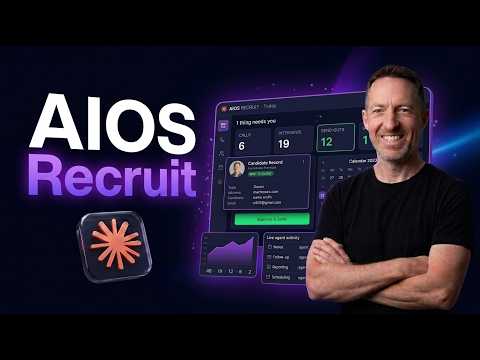
There's a summary as well with a voice recording here. There's also deal movement, so we can see it's prioritized at the top where Northstar looks like the most likely to close. And then at the bottom we have action that needs to be taken. So again, the VP now can spend his time closing deals, not putting together pipelines.
That is the benefit of AIOS. For those of you who don't know me, I'm Mike. I have 20 years experience selling professional services to global AI and SaaS vendors. I have worked with the biggest software companies in the world including ServiceNow, Zendesk, Datadog, Genesys.
And now I run an AI agency. We help teams like yours install AIOS, an operating system that empowers you and your team to use the teams and the tools that you're already paying for to grow output exponentially, to save money, and above all, make money. If anything in this video sounds like your company or resonates, click the link below, book a meeting, 15 minutes, and I'll let you know whether it's a fit or not. This is essentially a visual representation of AIOS.
It's what it would potentially look like in your business, except your business is different, so this will look different for your business because you have have your own set of unique bottlenecks and challenges that you want to solve. Capability one, Claude on your phone, Telegram, Slack, agents that pick up the phone or make phone calls for you. One subscription, same intelligence everywhere. Your sales team, for example, they work in chat.
Your engineers, they're going to be working in terminal. Your CEO opens a web application. Your customers call a voice agent. It's all going to be the same Claude subscription and the same context across your entire organization with shared memory.
This is the power of AIOS. Capability two, connection. Your agents reach into the tools that you already pay for. We can also help you reduce your subscriptions on tools with AIOS.
Your CRM, Google Drive, Supabase, Slack, Stripe, whatever you run on. The protocol is called MCP, model context protocol. It's built by Anthropic. It's an open standard.
It means one Claude subscription across your entire organization can read an entire data set and take real action across every system in your stack. One brain plugged into everything, no new tools to install. Capability three, automation. This is a big one.
Same work runs every week, every day, every hour. You and your team should not be the ones running it. Pipeline reviews Sunday night, dashboard reviews Monday morning, monthly reports Tuesday morning. The agent runs by itself, but the work will land in your dashboard or the interface of your choice.
And it works 24/7. Same Claude subscription, but on a schedule and fully automated. So now, excuse me, so now AIOS is working for you to help you save time and make money. Capability four, applications.
This is very cool. Not every agent should be in a chat. Some work needs a dashboard. A dashboard or an analytics tool that your team opens Monday morning to figure out what to do next in the business.
So you need to see this. We build small custom applications built on top of AIOS using the same subscription across your organization. The data is current and concurrent. The actions are ranked and the agents update all of these stuff, excuse me, and the agents update them in the background.
Same brain, new interface only when it's needed. So there it is, four capabilities, one Claude subscription, one operating system. AIOS. Let's look at how we built this.
Let's do kind of a semi-deep dive. dev, which is a triggering tool that allows you to trigger web webhooks and automation. So we have a Sunday night pipeline trigger set up, and all we need to do is go replay run, and then replay run, and then that that will actually trigger the automation. And also, we can set this up in an automated way to run every Sunday night.
Next, we have n8n. You can see here this is running right now because of the trigger automation that we just triggered. So, we can see that has triggered successfully. We're going to unpin this data.
It goes into webhook. It goes into some CRM sheets and some Google meeting notes. So, that is here. This is the CRM data and this is the Google Meet notes and this is what I was talking about earlier whereby AIOS is an agentic AI system that takes data from disparate data sources and brings it together.
And this is the automation. I'm using n8n because it's visual, but we can actually custom code this for you. So, we don't actually need to have an n8n subscription in your organization. We can custom click code this in Claude code.
There's a node Excuse me, a code node that brings this in brings the disparate data together and then it sends it to Claude again through your single Claude subscription. And then there is a parse code JSON node which parses the data. And then that get that gets written to Supabase which is our database for this project. And you can see we got a tables here and the actual database.
So, yeah, information gets sent into Supabase which is our database through that node in n8n. And again, we can custom code this for you in Claude code. So, you'll technically need a Supabase subscription, but actually we could keep the data in a Postgres or something like this in your Claude code. And then this gets sent to an ElevenLabs node and we've built an agent in ElevenLabs here.
So, this is allows us to interact with the the pipeline using ElevenLabs. They have an API too. So, we can write an API an API MCP into Claude code so that that is all connected. And this goes back to the connections that we create for you in AIOS through MCP, which is model context protocol, which is a protocol by Anthropic that allows for AI to interact with external services.
It's basically like an API for AI. Next, it goes to a named audio file, and then next in the automation, we have update summary with audio URL, and then that gets sent to a respond to webhook. So, then that gets sent back to the voice agent for uh so you can actually interact with the agent, and that also will create a pipeline for you, which is This is actually update summary with audio URL, and that This is the uh the node that will create the uh the pipeline. So, cool thing about dashboards is we can create whatever you want to see, whatever your business is having bottlenecks with, or you know, you're spending a lot of time on some manual processes somewhere, we can automate all that using AI, and then we can allow you, the business user, to interact with that data via different interfaces.
You know, it can be web, it can be dashboard, it can be voice, or it can be actually in Claude Code terminal. One subscription, multiple interfaces. And again, this is the the dashboard with the deal movement, the summary, and the actions that need need to be taken. That is a brief summary of the automation.
And if you have any questions regarding this build or this actual application sitting on top of AIOS, please leave a comment in the comment section. I'm happy to try and answer any questions that we can. If this is interesting for you, if you could see this, if you can imagine this in your business, then click the link in the description and apply for installation. Every application gets a personal reply from me.
We'll do some research before the call. And if we're a fit, we can move forward on implementing some aspect or all of AIOS for your business. Again, the benefit of this is it's Agentyx AI, it's automation, so it helps you save time and even make money by orders of magnitude. We're working with one customer now and we're actually doubling their output and giving them a 50% increase in some of their revenue.
So, thank you for watching. Click the link in the description and I will see you in the next one.
Auto-generated from the video's captions and lightly edited for readability. Commercial terms are covered on a call, not here.