How Large Companies Actually Use AI (And How to Copy It)
Enterprise AI isn't chatbots or better prompting. Companies like ServiceNow and DataDog consolidate data into one source of truth, then build an orchestration layer on top. That used to take a data team. Here's the same playbook running on our own business - and the numbers it produces.
Key takeaways
- The enterprise pattern isn't better prompting - it's one source of truth with an orchestration layer over it.
- Live on our business: 6 agents across 3 departments, 11 automations, ~400 agent runs a month, knowledge graph scoring 96/100.
- That's 130+ hours a month of redundant work - more than a full-time hire, roughly $5,000/month - with every action drafted by an agent and approved by a human.
Full transcript1,299 words
Most people have no idea how large enterprise use AI. It's not chatbots. It's obviously not just prompting ChatGPT. It's not doing tasks a little bit faster.
It's one thing, their data. And once you see how this actually works, you cannot unsee it. And that is what this video is about. So, stick with me because by the end, you will look at AI different in your business, completely different.
But, why listen to me? I'm Mike. For 20 years, I was one of the top technology recruiters in Asia. My job was to identify and recruit top talent for some of the biggest AI vendors in the world.
Apple, DataDog, Workday, Zendesk. For two decades, I worked with these companies. I saw how they think, how they build, how they win. And here is the pattern I saw again and again.
Companies like ServiceNow and DataDog are not selling AI. They're selling a way for customers to take their data and put it in one place, a single source of truth, and build tools, automations, and an orchestration layer on top of it. The big companies have been doing this for years. Most small companies had no idea it was even happening.
And until recently, you needed an entire data team and a big budget that most founders just don't have. But, that just changed. And I'm going to show you exactly how. So, here's what I'm going to show you today in this video.
One, how the big companies use their data to win, the concept. Two, the exact system we're building to do the same thing in our business. We're going to walk you through the DynaFlow AI OS orchestration platform. And three, the ROI, because you probably want to know most of all, what's in it for me, and how can this benefit my business?
We're not just talking about this, we're doing it. And we're going to show you the real numbers in the end. A quick thing before we get into it. If you're a busy founder or business owner watching this, if you want this inside your business, but you're too busy to do it yourself, let us help you.
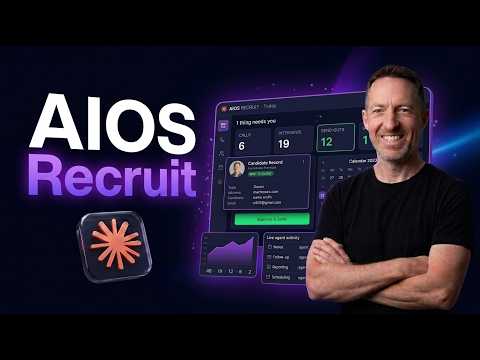
There's a link in the description. Let's get connected and we'll show you how. Now, let me show you how this runs. This is AIOS.
It's the operating system we're building for our company. And the whole idea behind it is really quite simple. Take everything your business runs on and put it on a single orchestration layer. That's the thing that lets a small business leverage its data the way big companies do.
It starts with the boring part that matters the most. Connecting your data, your CRM, your email, your drive, your Slack, every tool your business is already using pulled into one place, reading from one source of truth. Then, it gets mapped into a knowledge graph. This is your company's data structured so an AI can actually use it.
Who your customers are, what you sell, what's worked before, how you really operate. This is the part the big enterprise companies spend millions actually building. And this is sitting on my screen right now running our business. And it's scored 96 out of 100.
The healthier it is, the smarter everything on top gets. For the context layer, we use Atio CRM. It's an AI native CRM. Every contact, deal, note, it all goes here.
This is the memory. When one of my agents takes notes or takes action, it reads from the CRM, which is in itself a context layer. The agent knows the customer, the history, the context. So, this is the difference between an AI that sounds generic and an AI that actually sounds like the voice of your business.
Now, on top of the data, you build the agents. You organize them like a company. Each agent is like an AI employee with one job. A prospect agent, a follow-up agent, a meeting note-taking agent, a content writing agent.
Right now, we have six agents across three departments. Each agent reads from the knowledge graph, so the output sounds like us, not a robot. And these agents are not running rogue. This is important.
They draft, they propose, and then they wait for our approval. We are in the loop. The AI does the heavy lifting, and we make the decisions. And in the end, this is what it's all about, making better decisions.
In our opinion, it's the only way to run a real business. Then you let it run. These are the automations. A trigger fires, and an agent takes massive, intelligent action.
A new lead comes through our website. The research agent pulls everything we know about the lead and drafts an email and a reply for me. A meeting ends. A note-taking agent drafts the notes from the meeting and also writes an email for follow-up.
It takes action based on the automations. Every morning, before we even wake up, the cockpit agent tells us exactly what we need to do that day. It gives us a summary of the day ahead. And this is all automated.
It's the system doing the work. It's the system doing the work off the back of our data. 92 of these have run in the last 7 days alone, and we're just getting started. You could too.
We run the entire thing from our phone. Slack is the interface. The agents tell us what they've drafted. They give us a heads-up on what needs our attention.
Approve with the tab. The factory runs whether we're there or not. So, let's take a step back and look at everything from a high-level view. All of our data in one place.
Agents working 24/7. A sales and marketing engine that gets smarter every day. This is the big company playbook. If any of this sounds interesting, or if you'd like to get started today, link in the description.
If you simply want to connect with me to understand how we can benefit your business, click the link. Now, let's look at the ROI. This is the business. Six agents, 11 automations.
About 400 agent runs every month. One platform. It's all pulled from the dashboard. Every one of the automations is redundant and a redundant task a human would otherwise do.
A meeting write-up, a lead researched, and a reply drafted, a follow-up prepared, content drafted, and inbox triaged. Add it up and it's over 130 hours of work a month. That is more than a full-time hire running quietly in the background off the back of our data. Put a conservative of number on that and you're looking at roughly 5,000 USD per month.
The work grows. This is the curve you want in your business and this is what you want sitting on your business. This is the ROI. So, if you only take one thing away from this video, please let it be this.
Your data was always your edge. You know your customers better than anyone. You know what works in your business best of all. You just didn't have it connected into AI.
The big companies do. And now you can, too. We're building this whole thing in public and we'd love for you to follow along in the journey. So, if you like what you've heard today, please subscribe to my channel and comment on what you want to see next because your comments are very helpful and they give me context as to what I should make in the next video.
If you want to build with us, click the link, fill out the form, and let's get connected. And I'll see you in the next one.
Auto-generated from the video's captions and lightly edited for readability. Commercial terms are covered on a call, not here.