Two Days a Week Back Per Recruiter: The AI Hiring Math
A high-volume recruiter runs 30 to 50 first screens a week at 15 to 20 minutes each - ten to fifteen hours gone. Automate 80% of them and that recruiter gets two full days back, every week. Four use cases with the arithmetic done: screening, scheduling, reactivation, knowledge base.
Key takeaways
- Screening: 30-50 screens a week at 15-20 minutes each is 10-15 hours. Automating 80% hands one recruiter two days back - across ten recruiters, 20 extra days of capacity.
- Scheduling: 50 roles a quarter at three interviews each is roughly 150 booking events and nearly 40 hours a quarter, spent entirely on calendar Tetris.
- Reactivation: a new applicant costs $50 to $1,000 to acquire; re-engaging one already in your ATS costs near zero. At 5,000 past applicants, a 5% response puts 250 warm candidates back in play.
Full transcript2,087 words
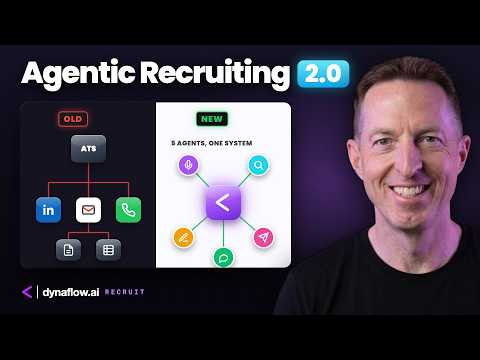
AI is everywhere right now. Everyone's talking about it, but people are mostly just using it to write emails and summarize meetings. Meanwhile, we've been using Claude Code to run entire hiring processes. To the moment someone applies, to screening them on the phone, to booking them into an interview, to following up when they go quiet.
In this video, I'm going to walk you through five real use cases. I'll show you how the workflows actually work, where the money gets saved, and I've got live demos so you can see this stuff in action. All right, let's jump in. If you're new here, I'm Mike, founder of Dynaflow.
I've spent over 20 years in recruiting, mostly placing senior tech talent across Asia Pacific. I have run literally thousands of hiring processes. I know what breaks, what scales, and where the bottlenecks are. So, everything I'm about to show you comes from that, not a vendor pitch, just what works when you're trying to fill roles and jobs fast, but without burning out yourself and your team.
Use case number one. First one, this is the big one, candidate screening. So, here's the problem every TA team has. Someone applies and then nothing happens for two or three days.
Your recruiter is buried in 30 other roles. By the time the recruiter calls, the candidate's already accepted a screen or even a job somewhere else. So, what if that happened in minutes instead? Let me show you the demo.
Hi, Mike. This is HireVoice calling for Elon Musk about the sales manager role at Tesla. Is now okay for a brief chat? Yeah, now's a good time.
Thanks. What's motivating you to consider a move right now? Can you tell me a little bit about the company? Sure.
Company, Tesla. It designs, manufactures, and sells electric cars and renewable energy products. Known for innovation and a strong commitment to sustainability. What's motivating you to consider a move right now?
Can you tell me a little bit about the job? The sales manager will oversee the sales team for EV sales, train staff, develop sales strategies, and analyze market trends to hit targets. What's motivating you to consider a move right now? I'm motivated by making more money and working with a cool team with cool company culture.
Got it. Growth and culture. What compensation range are you targeting? I'm looking for about 130,000 USD per year.
Thanks. What would be an ideal next step for you? As a next step, I'd love to be a sales manager in my next job. Now, let's talk numbers.
So, this is the candidate screening agent. A recruiter doing high volume hiring runs maybe 30 to 50 screens a week. Each one takes 15 to 20 minutes. That's 10 to 15 hours a week just on first screens.
And most of those screens and candidates don't make it to that stage. So, if an AI agent can handle 80% of those screens, that's 80% and it can absolutely can for structured roles, your recruiter just got two full days back, which is insane. Every week. That's not efficiency, that is actually a different job.
So, for an agency with say 10 recruiters, that's 20 extra days of capacity. That's placements and revenue. Okay, second use case, interview scheduling. This sounds boring.
It is boring. That's exactly why you should automate it. So, currently you and your team screen a candidate, you decide she's good, and then you spend minutes, hours, or sometimes days playing calendar Tetris, checking hiring manager's availability, sending a link, getting a reply, having to do a reschedule, sending another link. It's exhausting.
Multiply that by 30 candidates a week and you and your team is spending a full day just booking meetings, which is insane. All right, let's check out the demo. Let me pick near-term time for a quick intro. m.
Eastern. Which works? m. m.
Eastern. One moment. m. Eastern.
Thank you for your time. Elon Musk looks forward to meeting you. Thanks. I look forward to meeting Elon Musk.
All right, great. So, what's going to happen next is first of all, the recruiter is going to get an email and it's going to look like this whereby the recruiter just needs to wake up in the morning, see this email, click accept, and then that will get booked into her calendar as a Google Meet. So, for a team hiring 50 roles a quarter with three interviews at each stage, that's roughly 150 scheduling events. At 15 minutes each, and that's conservative because reschedules and time, you're looking at nearly 40 hours per quarter just on scheduling.
40 hours a quarter on scheduling for your team, okay? Which is, I know I'm saying this a lot in this video, but insane. So, automate that and you've freed up a week of recruiter time for every quarter. Per recruiter.
So, that's money. That's revenue. All right, quick aside. " I run a free AI efficiency audit.
No pitch, no demo. I spend a few hours researching your company beforehand. Then we get on a call and I ask you and your team how your team actually works. You'll walk away with a written report showing you two or three high-impact places that AI can save you time and even make you money.
If you're interested, the link is in the in the description. Meetings are limited this week and next week, so click now. Click the meeting, let's get connected. Third use case.
This is the one that most teams completely ignore, candidate reactivation. So, check this out. Think about how many silver medalist candidates you are sitting on in your CRM or your ATS. People who've made it to final rounds, they were strong candidates, but somehow or some way they didn't get the offer.
They they placed number two. Or the role got put on hold or timing just didn't work out. I mean, there's a thousand things that can happen so that candidate didn't get the job, but she's good. She's a good candidate.
She's silver medal. Let's jump into the demo. Hey, this is John calling from the talent team at The Specialized Group. I'm reaching out because I saw that you recently applied for the technical product manager position.
Am I speaking to James Rodriguez? Yes. Perfect. com still the best email to reach you?
That is correct. Great. Thanks for confirming that. So, tell me, what made you apply for this particular role?
What caught your eye? I'm interested in cutting-edge AI technologies. That's really interesting. Thanks for sharing.
And in terms of compensation, do you have a salary expectation in mind for this position? I'm hoping for around 85,000 USD. Thank you for letting me know. One more thing.
Are you happy with a fully in-office setup or would you prefer something hybrid or remote? I would like something fully remote, please. I'm curious. When you were looking at this role, were you more drawn to the compensation package or was it more about the location and the type of work?
More about the type of work. I'm interested in AI. Thanks for sharing that. And if you had to choose, what matters more to you right now?
Career growth and learning new things or stability and work-life balance? Career growth by far. I'm really interested in taking it to the next level with voice and AI. Thanks so much for sharing all of that, James Rodriguez.
Your cost to require a brand new applicant, um, you know, through job board fees, uh, LinkedIn recruiter time, sourcing tools, LinkedIn, very expensive. It's anywhere from 50 to 500, maybe even 1,000, depending on the role and depending on how many tools you're using. Your cost to uh, activate someone already in the database is near zero. So, the AI agent will do the outreach for you.
It we can automate all of this for you. If the candidate bites, they go straight back into the pipeline. It's a it's a huge bonus. So, for a team with 5,000 past applicants in your ATS, let's say you're a recruiting company or you're a TA team or whatever and you have like 5,000 candidates in your database.
Excuse me, even a 5% reactivation rate, excuse me, 5% reactive reactivation rate puts 250 warm candidates back in play. That's a hiring campaign's worth of pipeline for the cost of just a few phone calls. It's worth it. Okay, fourth use case, internal knowledge base for your recruiting team.
Every TA team has this problem. A recruiter needs to know what's the relocation policy for Singapore or New York? What's the approval salary band for a senior engineer in Tokyo? Can we offer a sign-on bonus?
What's my commission structure? What is the policy for sick leave or vacation? So, what happens is that person will ping their manager or the lead or the HR. They dig through SharePoint for like 20 minutes and they find a document from like 2023, which may or may not still be relevant.
We will create a recruiting knowledge base for you or an HR knowledge base, an internal knowledge base for your company. And what you're looking at is a knowledge agent trained on your company's actual policy documents. Let me show you a quick demo. So, this is let's say this is a knowledge base for actual candidates and I want to find my top back-end engineers.
So, I'm going to do some voice commands. We're voice experts, you're a voice expert, so let's check this out. Show me my top back-end engineers. And voila, we're getting our top engineers.
Now, this can apply to candidates in your ATS or it can apply to HR and policy. So, what you're looking at is a knowledge base and it's an agent trained on your company's actual policy or candidate data. So, for example, compensation benefits, benefit guides, relocation policies, offer approvals, commission structures, commission plans, workflows, KPIs, compliance requirements, and the recruiter can ask the question in natural language. The recruiter or the person, whoever, whoever has is part of your company wants to ask internal questions.
The agent finds the answer and this is the important part, shows exactly which document it's pulled from. So, you can see the source, you can verify it. This isn't AI guessing, it's retrieving and citing actual information from your company and your structure. If you have a team of 15 recruiters, let's say for example, policy questions happen dozens of times a day, sometimes.
And each one interrupts the team, interrupts the HR manager, the hiring manager, the country manager, or just the the co-worker sitting next to the person. Not that you don't want banter in the office, it's great, but you want people focused, right? This kind of interruption breaks the focus. So, over a year, if you compound this exponentially over a year, you're looking at hundreds of hours spent answering the same questions that are already documented in your knowledge base.
So, this isn't about replacing your team, it's not about replacing HR, not at all. This is about giving them their time back and not making them help desk. Those are the four ways how AI is changing how recruiting operates. Not in theory, not in some future state, right now.
We saw the demos, this is live stuff, production stuff that's happening with our clients right now. None of this replaces recruiters, by the way. It replaces the admin that stops recruiters from doing what they're actually good at, talking to people, selling roles, and closing deals. And if you want to figure out which of these would move the needle for your team, I'll do the thinking for you.
Just book the free audit. I'll research your company, we'll get on a call, and I'll show you exactly where the highest impact opportunities are. So, just go ahead and the link is in the description. Let's meet up and let me help you transform your business using AI.
All right, peace out. See you in the next one.
Auto-generated from the video's captions and lightly edited for readability. Commercial terms are covered on a call, not here.