Every Department Running on AI Agents: A Full System Tour
Marketing, sales, finance, engineering - every department in this business is an agent, not a person. This is the full portal tour: how agents get hired in two clicks, how routines run on a clock, and how one shared knowledge base keeps every agent reading from the same facts.
Key takeaways
- Hire an agent in two clicks - pick the department, write the job description, and it arrives with skills installed and the company's context already loaded.
- The knowledge base repairs itself hourly: stale runs, broken references, and 44 orphaned events in one pass get fixed or flagged, so what agents read from doesn't decay.
- One Claude subscription replaces a dozen SaaS tools, and the same agents are reachable from the portal, Slack, or Claude Code over MCP.
Full transcript2,990 words
Marketing, sales, engineering, finance. Every department in my business runs on AI agents. My head of sales, head of marketing, head of engineering, chief of staff, a finance lead, a proposal writer, every one of them is an agent. At any point, I can open any one of them and see what they're trained on.
The files they reference, every task they run on, change any of their settings on the spot. An entire finance department plugged into Google, telling me where the cash sits and what's overdue. I hire a new agent anytime I need one. Pick the department, drop them in.
They come pre-built with the skills installed for business owners, already running on this. The whole thing runs on one Claude subscription and connects to every tool I use. Gmail, Slack, GitHub, Google Drive, all of it. I invite my team into the right departments and they all work with the same agents.
And every agent reads from one company knowledge base. So, they all share the same information. If you're a business owner and you want me and my team to install this for you, link in the description, comment in the comment section. I'm Mike.
I run a company where every department is an agent. Marketing, sales, finance, engineering, all running on a single AI operating system that my team and I built. It runs my business right now, routines that fire automatically, agents that share one knowledge base. Work that would otherwise need a payroll is running while I sleep, literally making money in my sleep, as you can.
I built this because we needed it. Necessity is the mother of invention. A real operating system for a business. One that scales when I add more agents, learns from every routine that it runs, powered by one Claude subscription.
So, now we install the same architecture inside other companies to help them exponentially improve their business. Same agents, same memory, same wiring, customized to how your business runs, and operational in weeks, not years. ai and click apply. Likewise, link in the description.
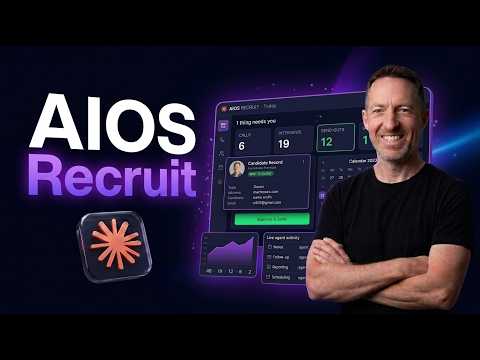
So, what is AIOS and why should you care? AIOS is an agentic system that will allow you to completely automate your business, thereby saving a lot of time, not having to hire more people, and ultimately make more money. You can really take your business to the next level if you're implementing this into your business at a system level, which is essentially agentic AI into your infused into your business. This is the dashboard view.
This is a dashboard that we are building for a customer, an actual customer, and I'm going to walk you through all the sections of the system, which will give you a better understanding of what AIOS is and why you should implement it to your business. But, quick context, AIOS runs your business and it runs on agents. Marketing, sales, finance, engineering, all one shared knowledge base, one bill. This is the portal version that we're looking at.
You can drive the same agents, however, through any interface, including Claude Code on your terminal, from Slack if you're out and want to do mobile, from whatever interface you can imagine. And why would Again, why would you care about this? Well, you can ship more without hiring more, essentially, with this method and with this system. You get more output, lower payroll, and ideally you're saving money and making money.
So, the cool thing about AIOS is you can interface it Excuse me, you can interface with it from any interface, including Claude Code, Slack, or this portal that I'm going to show you. So, this is the dashboard. This is where the live state of your business is sitting, Every agent, every job in flight, every decision that's waiting on you in real time. It's all happening in real time.
You don't need to go looking for what's happening here. You can see everything on one screen. This is sort of like your NASA command center view. So, you've got active agents, open issues, pending approvals, runs this week.
And this is all completely customizable. Departments. Same structure as a real company. Every agent belongs to a department the same way a person on a payroll would.
Marketing, sales, finance, engineering. So, here we've got marketing, admin, sales, engineering. And the org has structure just like your company does. And you can see it here.
So, these are all agents under the actual function. So, you've got your marketing agents, your admin agents, your sales agents, and your engineering agents. Speaking of agents, this is the agent view. This is the heart of the system.
Agents are your employees. Each one has a role, a manager, and a a defined scope of what they can do and what they can touch. You hire them in two clicks. You retain them on the spot.
e. fire them, when you don't need them anymore. They're expendable cuz they're agents. So, they work on a schedule.
They're automated. You don't have to pay them. And agents remember everything that you've told them. They remember everything in the organization.
And every one of them shows up already aligned with the rest of the organization cuz they all share the same context. And I'm going to show you that in a minute. Let's say for example, I want to hire a sales agent. So, I'll call this sales agent Sam.
His title will be SDR5s. SDR sales development rep. This agent will report to me, and the department is sales, and then we give it a a job description. Your job is to perform an outbound campaign on Instagram based on the leads that we're getting from our recent event in Singapore.
So, that's the job description, which is like a system prompt, and then you click hire agent, and it's that simple. We have just hired an agent. Routines. Routines are the work that run without you.
Essentially, this is the automation part of the platform, and they run on a clock. So, for example, Sunday night, you get next week's content plan, which will be, you know, on your desk Monday morning. You can run on this on a trigger. Everything can be triggered.
And a meeting ends, and the transcript is processed for it. So, for example, a Google Meet will produce notes that will get automated and then infused into your CRM. It will get logged and turned into follow-up tasks before you even finish the meeting. This can happen.
So, you set all of this once, and then it runs automatically in the background. And so, this is where a lot of the compounding and the leverage shows up because this is the automation section where we can actually automate your business. Activity. Every section of your agent will leave a trace of something.
Click any row, see the full chain, what the agent thought, and what tool the agent picked, and what output the agent produced, how much it costs, you know, the tokens. So, in the activity view, there's no black box. This is like your logging view, so you always know what's going on in your business in real time. So, we For example, we can click into this activity.
This is the Sage agent. We can see the input payload, which is basically some JSON data, and then we can also see the actual output from what this agent produced. m. NZ by digest delivered.
And so, you can see all this. These are like your logs section. Knowledge graph. This is the memory of the company.
Every fact about your business, it's all here. Clients, contacts, projects, conversations, it's all stored once, it's structured, it's connected to everything, and it relates to everything. So, every agent reads from the knowledge graph, and every agent writes back to the knowledge graph. You update something once, and the whole company knows.
This knowledge graph, incidentally, is based on the concept of the Karpathy LLM Wiki, which was written by Andrej Karpathy. I'll leave a link to this in the description. But, essentially, the idea around this is instead of just retrieving from raw documents at query time, which is like the rag way, the LLM incrementally builds and maintains a persistent Wiki, a structured interlinked collection of markdown files that sits between you and the raw sources. So, what we're looking at here is a visual representation of Karpathy's knowledge graph.
And so, we have on your system raw data and sources and information, and then on the end we have the LLM and the agents, which are doing things. And then in the middle, we have a a library or a Wiki. And then this is it's all connected through the knowledge graph. So, we can see over here our Gmail is connected to these agents.
We can see over here our Supabase, which is our database, is connected to these agents. So, it's a cool way to have a visual representation of your business as a knowledge graph. Optimize. The memory of the company maintains itself.
Every hour, the system checks for stale data and things that contradict each other, missing information, broken links, broken facts, and the system will fix what it can, it flags what it can't. The quality of what your agents read from doesn't decay because things are self-updating. Now, Andrej Karpathy talks about this in his Wiki page here. So, it says here, "Noting where new data Excuse me.
" So, this will sort of happen in the optimization part. This is kind of like the sanitization of your data in the system. So, here we have uh seven stale runs. We have 44 orphaned events.
We have data gaps. We have missing refs and things that have been automatically fixed. This all happens in the automa- excuse me, in the optimize section of the portal. Skills.
Skills are abilities that your agents can pick up and get. AI creative, SEO audits, invoicing, proposals. You pick a skill and you assign it to an agent and then the agent has that skill immediately. This is how an organization grows and capability compounds without hiring anyone new.
So, for example, in this skills section, we have a century front-end design skill, which allows for the engineering agent to have front-end design skills. Down here, I don't know if you can see this, we have the century ad creative agent. I'll move it up here. And this will give your agent the ability to have an ad creative skill.
Think of the skills section as, you know the movie The Matrix? " And then they go into an epic fight. This is the same thing with your system. You're automatically and instantly giving your agents kung fu, depending of course on that skill.
Integrations. Integrations are the tools your take your agents use to act on the outside world. The outside world. Send a message in Slack, read a campaign in metadata, excuse me, meta ads, pull a pi- a pull a pile pull a file from Google Drive, push a commit to GitHub.
Under the hood, it's the same primitive every modern AI model uses. The AI model is using the tool that we're looking at and the agent reasons, picks the right tool, and then brings information back to the agent via that tool, and the result comes back and then there's output. So, you're plugging your agents into the outside world and then the work actually happens. So, these are like function tool calls essentially, and it's similar to if you have Claude Co-work, you will know about this in the connector section.
You can connect Claude Co-work to various outside services like Gmail, Google Drive, Microsoft 365, Google Calendar, Canva. These are essentially through what we would refer to as function or tool calls. And with the AI OS portal, we call them integrations, but essentially this is connecting AI OS with the outside tool. So, what happens is an agent needs to do something, let's say it's an SDR agent, the one that I built previously, and needs to do a campaign on Google, excuse me, on Meta Ads.
So, it will call the Meta it will call the the Meta Ads tool, it will create the campaign, that will come back to the agent, and then the agent will use the Gmail tool to actually outbound email prospects from the event that you just did, and then that will come back, and then a prospect comes back and says I'm interested, then the agent will actually book a meeting for you on your calendar. This all happens automatically. The agent is doing all this and it's calling tools to do so. Connections.
Connections are the underneath wiring of your system. You have one Claude subscription and it powers every agent, every routine, every decision on on platform. It's all powered through your subscription to Claude or to whatever LLM you're using. So, you get one bill instead of 12 SaaS subscriptions.
So, we're helping you reduce your subscriptions, and we're also helping you reduce your tool usage or your usage of external SaaS services. We're trying to keep everything into one system to help you be more efficient and help you save money. And the same workplace, excuse me, is exposed to MCP. So, this is this is exposed to an MCP server, which is model context protocol, which means you can drive your agents from one Claude subscription.
You can use Claude code. You can use Claude code in terminal. You can use it from anywhere, and it's all one subscription. And the portal you're looking at right now is just one interface connected to AIOS via a single subscription using MCP in the connections section.
Next, let's go into a brief presentation, which will demonstrate the ROI and how powerful this can be in your organization and why you would want to use this for your business. me. Well, essentially, what's in it for you as you as a company owner or an operator or someone who's trying to scale, grow your business, turn your business around, simply save money, maybe even make money, this will save you massive amounts of time and make money. AIOS will save you time and help you make more money.
So, let's say for example, you were running four manual tasks every year. Well, in this situation, every week and then every month and then every year. So, for example, you have an end-of-day brief. You have a weekly marketing content plan that you're creating.
You are cleaning up the data in your database. And you are manually processing Google notes or manually processing CRM notes from a meeting. So, these are four different things that are being done manually. Let's extrapolate all of that into one hourly cost.
So, that that would cost four people doing this like an hour every day, $50 an hour or something like this. Again, these are extrapolated numbers, just an example. That would equal 11 hours per week spent on these four workflows. And if you add that up, that's $28,000 a year.
So, that's just for these four manual workflows that are happening. If we run this on AIOS, so it's the same workload, but it's automated and using AI on one platform, one subscription, and one install, we're talking a platform subscription, a one-off setup fee, and a small monthly hosting cost. That equals $10,000 a year. By By year two, you're down to $3,000 a year.
So, you're going from $28,000 a year to $3,000 a year. Payback in 20 weeks, which is how long it takes to install everything and get things going and start to realize the ROI. So, again, manual $28,000, AIOS $10,000, coming up to $18,000 in savings. Now, this is just four workflows manually done.
Okay? If you extrapolate that across your organization, it's going to compound and it's going to be hundreds of thousands of dollars in savings. We also tra- charge a monthly subscription fee. I can't tell you how much that is cuz it's custom to every organization, how big you are, how much you want to do with AIOS.
But either way, you're going to be saving yourself hundreds of thousands of dollars a year. And it compounds over time. This chart will show you SaaS plus manual tasks without using AIOS, without using AI and automation. It's kind of a linear line, this gray line down at the bottom.
But with one knowledge base, a skills all installed at once, and routines that are automated, you can see AIOS will start to make your business grow faster, get better, and this will happen exponentially. This is the exponential hockey stick that is going up, eventually into a straight line. And again, the benefit for you is that you save time, you make money, and you can do things that you want to do. Spend time with your family, go on vacation, make money in your sleep.
Hope you enjoyed this. ai and click apply. See you in the next one.
Auto-generated from the video's captions and lightly edited for readability. Commercial terms are covered on a call, not here.